Overview
Customer matching tells weintegrate which QuickBooks Online customer each Shopify order belongs to: either the shopper’s own customer, found by comparing one field from the Shopify order with one field on your QuickBooks Online customers, or one catch-all customer for all of the store’s sales. When a shopper’s own customer isn’t in QuickBooks yet, weintegrate can create it for you or use a default customer you choose, depending on your If Customer is not found then setting. You set it up in the setup wizard, and the settings are saved for the Shopify store you’re connecting. Each store you connect has its own customer matching settings.
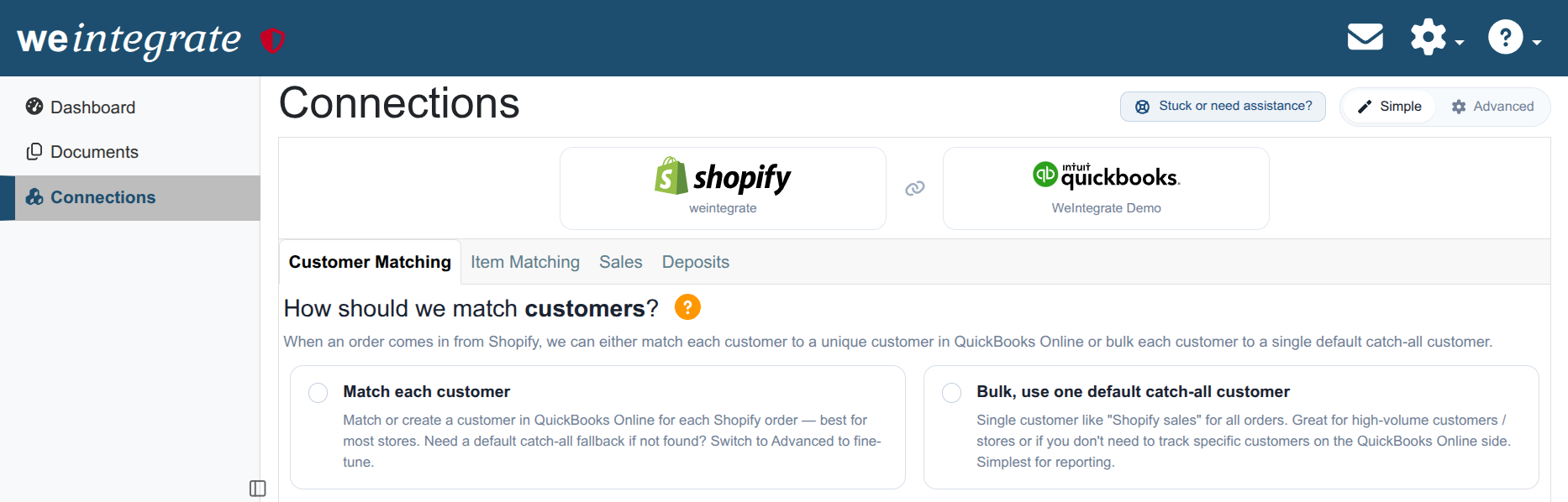
Almost every setting is filled in for you with a sensible default, so most stores only need to make one choice and select Continue.
Quick setup
- On How should we match your customers?, select Match each customer (best for most stores) or Bulk, use one default catch-all customer, then select Continue.
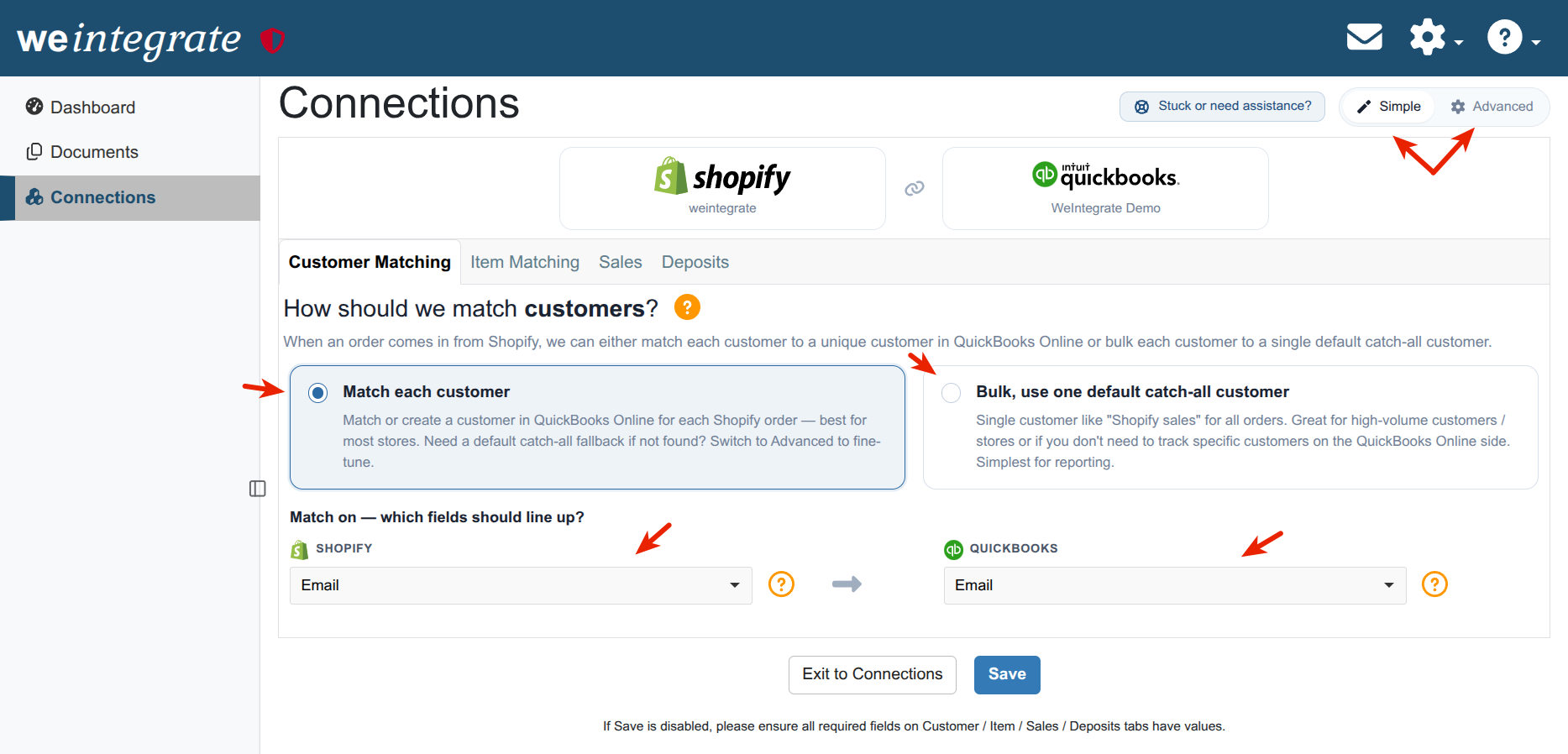
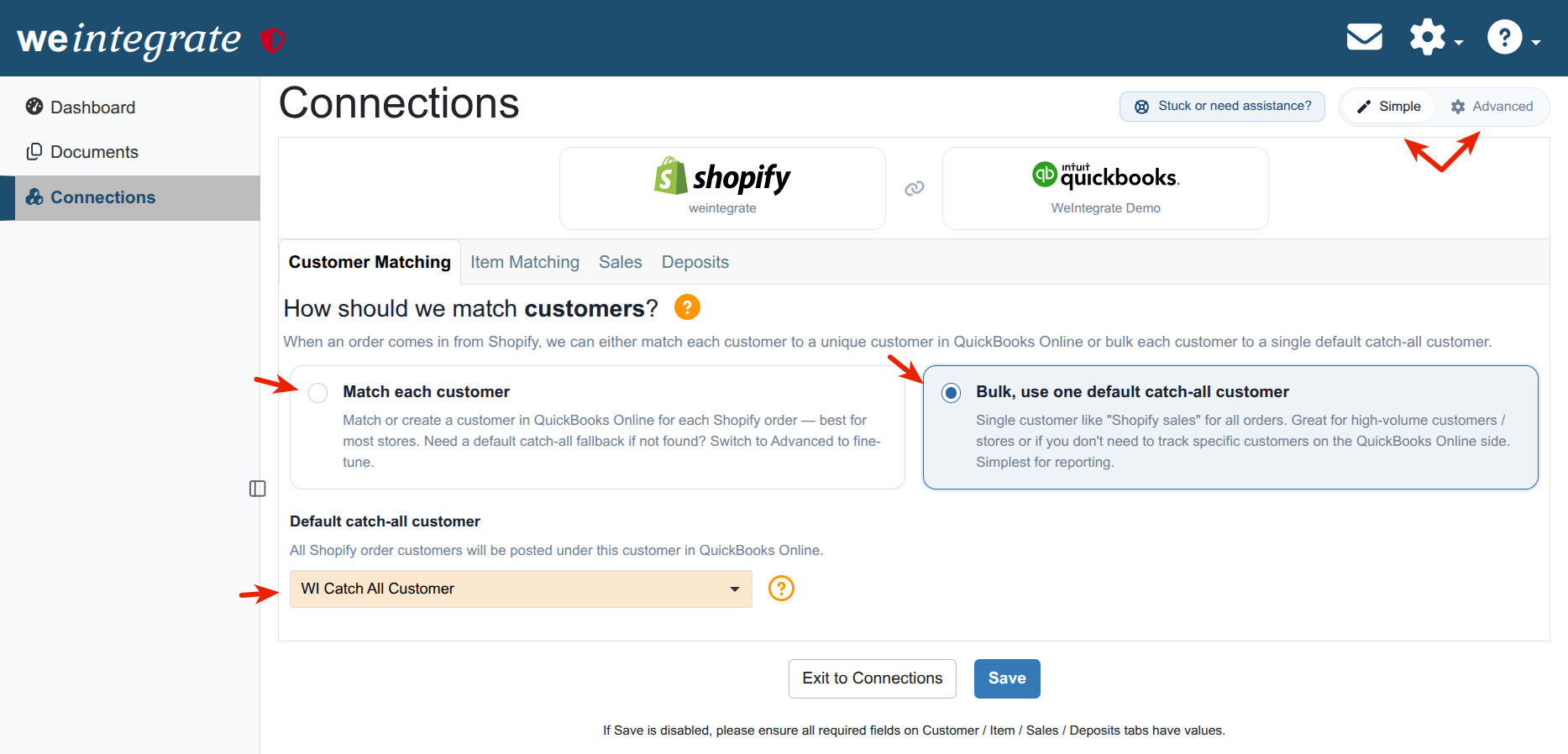
- A few steps later, on How should we match customers?, check the preselected values:
- Match each customer: Match on is set to Email ↔ Email, so an order from
jane@example.comgoes to the QuickBooks customer with that email address.
- Bulk: Default catch-all customer is set to your existing WI Catch All Customer, or to Auto create for me if you don’t have one yet.
- Match each customer: Match on is set to Email ↔ Email, so an order from
- Want to fine-tune? Switch to Advanced at the top right to see every setting. With Match each customer that includes If Customer is not found then and the secondary match; with either choice it includes the convert-inactive and update-address options.
- Select Continue to move on to How should we match products?.
Changes apply to orders synced after you save. Orders already in QuickBooks are not changed. You can change these settings any time in Connections → Edit Settings → Customer Matching.
Dropdowns with a light orange background list values from your QuickBooks Online company, such as customers, sales terms and payment methods. They’re preselected too (for example, in Advanced, Set Sales Terms as starts on Due on receipt when your company has that term). Pick a different value whenever another one suits your business better. If a required dropdown is still empty, for example because your QuickBooks Online company has no payment methods yet, Continue stays greyed out and a warning appears until you choose a value. In Simple mode, switch to Advanced to find the empty dropdown.
Guides for each setting
- Select bulk or unique customer matching in QuickBooks Online: Match each customer or Bulk, use one default catch-all customer, and choosing the catch-all customer.
- Set unique customer matching with primary match between Shopify and QuickBooks Online: the Match on fields, If Customer is not found then, and Advanced rules (Professional plan or higher, included with your Free Trial).
- Add secondary match to customer matching between Shopify and QuickBooks Online: a second way to find the customer when the first one doesn’t.
- If Shopify customer not found in QuickBooks Online, auto-create a new customer in QBO: Create New.
- If Shopify customer not found in QuickBooks Online, use a default customer in QBO: Use Default Customer.
- While integrating Shopify to QuickBooks Online, convert inactive customers to active: Convert inactive customers to active when posting new orders to accounting.
- While integrating Shopify to QuickBooks Online, update customer address: Update customer address in Accounting from newly received orders?
Next step
After customers, the wizard asks how to match your products. Set up Shopify integration with QuickBooks Online item matching covers the item matching settings you choose on How should we match products?.
Related topics
- Select bulk or unique item matching in QuickBooks Online: the same choice for products.