Overview
A secondary match is an optional second way to find an order’s customer in QuickBooks Online. It is tried only when your primary match finds no one. If neither match finds the customer, weintegrate can create it for you or use a default customer you choose, depending on your If Customer is not found then setting. The primary match (your Match on fields under Match each customer) is explained in Set unique customer matching with primary match between Shopify and QuickBooks Online; set that up first.
Example: primary = Shopify Email ↔ QuickBooks Email; secondary = Shopify Phone ↔ QuickBooks Phone. We look for a customer with the shopper’s email address, then, if none, one with their phone number.
Using one catch-all customer (Bulk, use one default catch-all customer)? Skip this guide — see Select bulk or unique customer matching in QuickBooks Online.
Quick setup
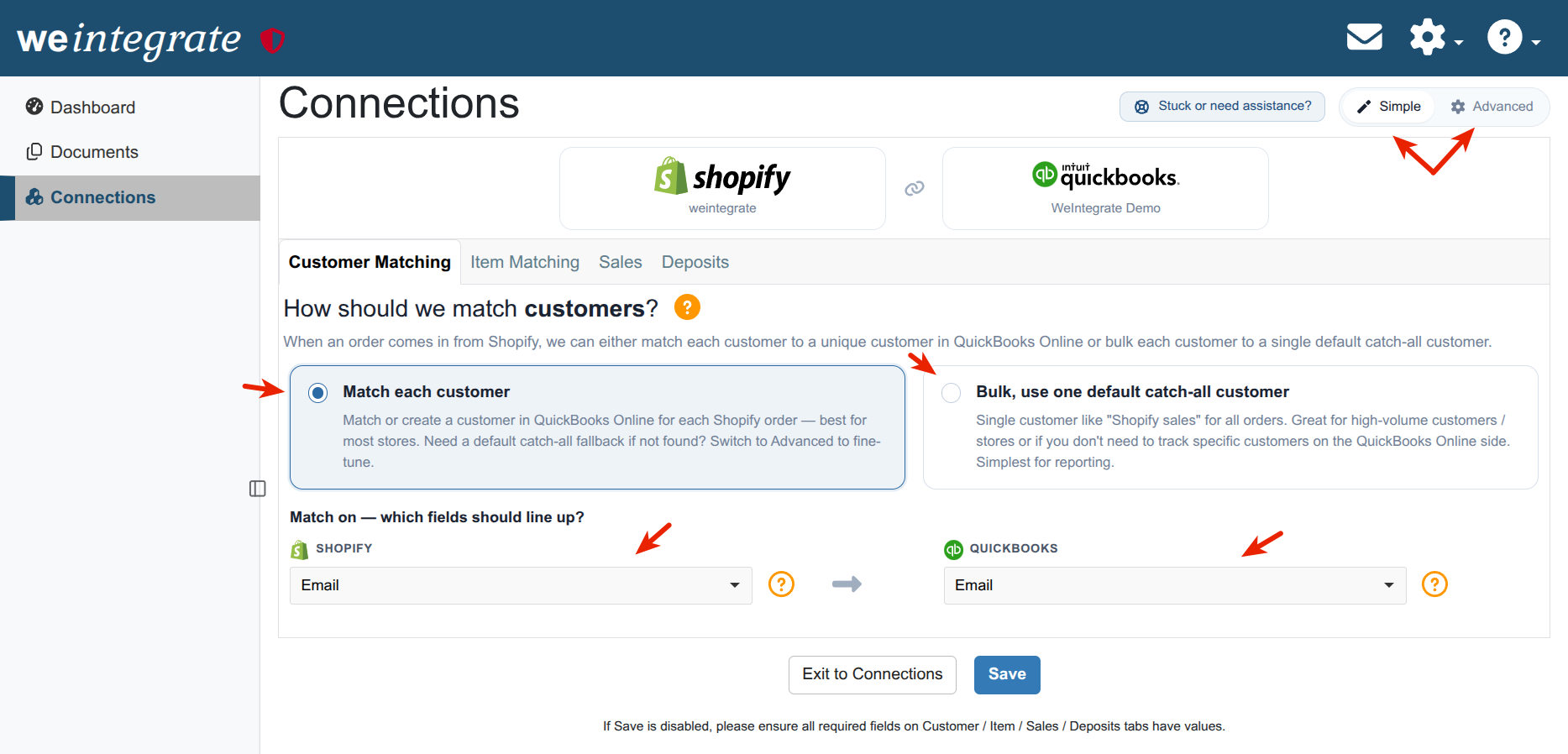
- Open the setup wizard’s customers step, or Connections → Edit Settings → Customer Matching.
- Switch to Advanced at the top (it isn’t shown in Simple) and select Match each customer.
- Below your primary Match on fields, tick Try a secondary field if above doesn’t find match.
- Under How do you identify your customers (Secondary Match in the event the Primary Match is unsuccessful), pick:
- SHOPIFY — the order customer’s value;
- QUICKBOOKS — the customer field to compare it with.
- Select Continue (setup wizard) or Save (Edit Settings).
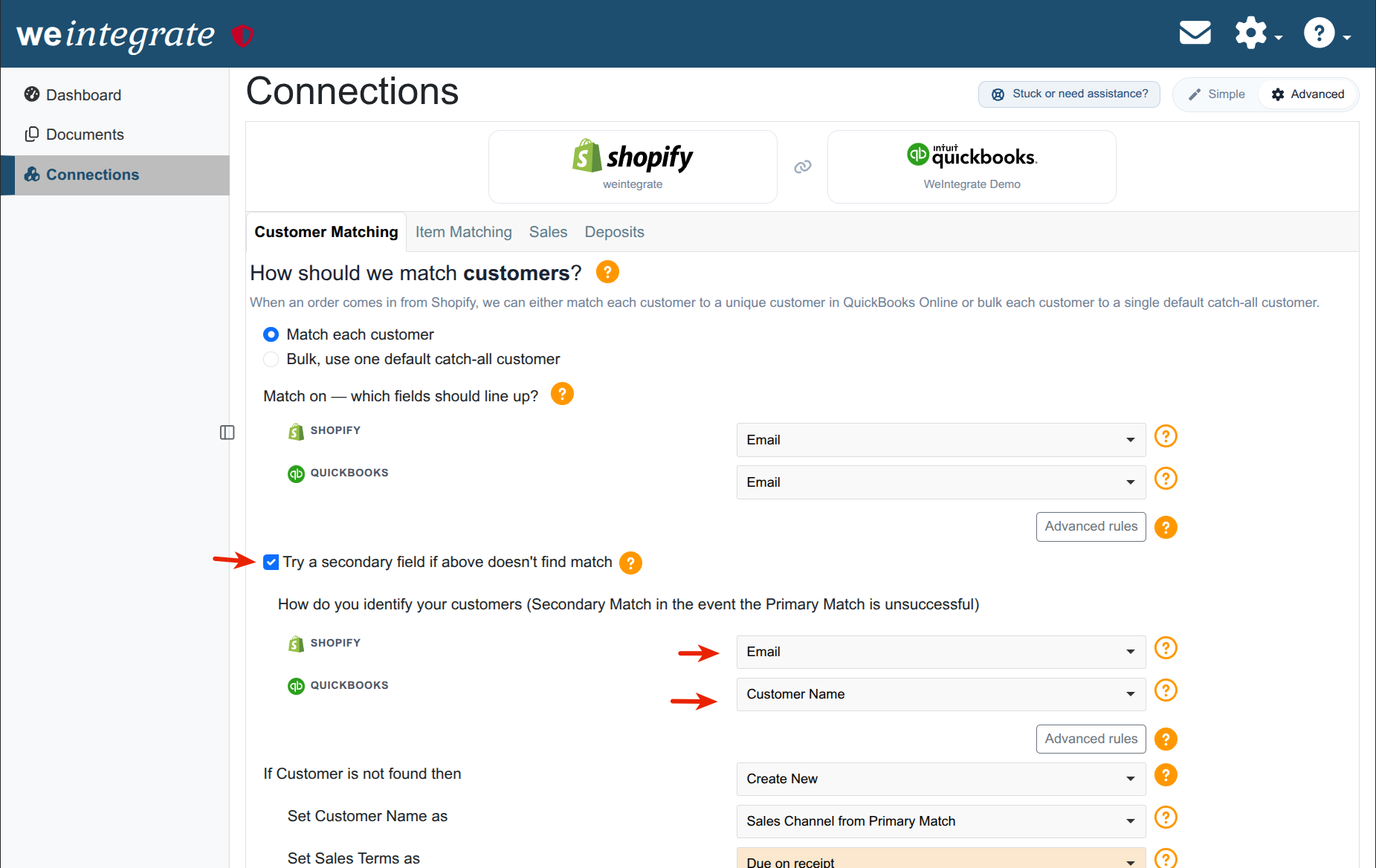
Tip: pick a pair different from your primary one (e.g. Email first, then Phone or FirstName LastName). Repeating the primary fields can’t find anyone new.
Changes apply to orders synced after you save. Orders already in QuickBooks are not changed.
If you don’t need Advanced rules, you’re done.
Your options explained
The secondary dropdowns
They offer exactly the same options as the primary ones — including Company Name, FirstName LastName and LastName, FirstName on the QUICKBOOKS side and showing the same “not unique” warning when picked. Each option is explained in the primary match guide.
When the secondary match is tried
For each order:
- Primary match — primary Advanced rules (if any), then primary Match on fields. If a customer is found, the order is recorded against them and the secondary match is not used.
- Secondary match — only if the primary match found no one and Try a secondary field if above doesn’t find match is ticked: Secondary rules (if any), then secondary Match on fields.
- If Customer is not found then — only if neither found anyone.
A customer found either way is treated the same, including your settings for converting inactive customers to active and updating the customer’s address (see Related topics).
If Customer is not found then
This runs when neither match finds a customer. With the secondary match on, Create New → Set Customer Name as (the Shopify value used as the new customer’s name) gets one extra choice:
| Option | Name taken from |
|---|---|
| Sales Channel from Primary Match | the SHOPIFY field of your primary match |
| Sales Channel from Secondary Match | the SHOPIFY field of your secondary match — shown only while the secondary box is ticked |
Example: with the Email / Phone setup above and Create New with Sales Channel from Secondary Match, a shopper not found either way becomes a new QuickBooks customer named after their phone number.
The other settings (Set Sales Terms as, Set Preferred Payment Method, Set Preferred Delivery Method, If Create New failed, Select Default from QBO, Use Default Customer with Select Default from QBO) are unaffected by the secondary match.
Click here to learn about Automatically Creating New Customers when integrating Shopify with QuickBooks Online.
For your accountant / bookkeeper: the secondary match only changes which existing QuickBooks customer goes on the sales receipt or invoice. It never changes amounts or creates customers — If Customer is not found then does that.
Turning the secondary match off
Untick Try a secondary field if above doesn’t find match and save. Then:
- Orders use the primary match only, followed by If Customer is not found then.
- If Set Customer Name as was Sales Channel from Secondary Match, it switches back to Sales Channel from Primary Match as soon as you untick the box.
- Saved Secondary rules are kept but not used.
Tick the box again and save to turn it back on, rules included.
Troubleshooting
I don’t see “Try a secondary field if above doesn’t find match”.
Switch to Advanced at the top of the page and select Match each customer. If the Advanced rules editor is open, select Exit Advanced rules first.
“Sales Channel from Secondary Match” isn’t in the Set Customer Name as list.
It’s shown only while Try a secondary field if above doesn’t find match is ticked, and only with Create New.
My secondary rules aren’t being used.
Check that Try a secondary field if above doesn’t find match is ticked and the status next to the Advanced rules button says Active — until then, orders use your standard Match on fields. Also, secondary runs only when primary found no one: use Test a value and Preview on your primary rules to check they don’t already find a customer.
I can’t change the secondary dropdowns.
They’re locked while the Secondary rules list has rules. Open the secondary Advanced rules, delete the rules, then change the dropdowns.
Secondary Advanced rules
Optional. Like the primary match, the secondary match can use Advanced rules — for example, to find customers whose QuickBooks names differ from what Shopify sends.
Who can use them — same as primary rules: the Professional plan or higher. During your weintegrate Free Trial they’re available, and the editor shows: “Advanced rules are included with your Free Trial. Professional or higher plan required to use them when you subscribe.”
How they work — the editor (operators, wildcards, Use Sales Channel value, Test a value, Preview, saving, activation) is explained in the primary match guide. Secondary rules run top to bottom; the first that finds a customer wins. If none does, your secondary Match on fields are the fallback.
Fields and preview — the same as for primary rules. Match Accounting field offers Customer Name, Company Name, First name, Last name, FirstName LastName, LastName, FirstName, Email and Phone. Hover over an option to tell the two names apart: Customer Name: The name shown for the customer in QuickBooks (its display name). Company Name: The Company field on the QuickBooks customer. It can be empty. FirstName LastName and LastName, FirstName only find customers with both a first and a last name. The preview shows QBO ID, Chosen match, Rule, Customer Name, Company Name, First name, Last name, Email, Phone and Active.
Where to find them — the second Advanced rules button, under the secondary QUICKBOOKS dropdown. It opens the Secondary rules list.
Example: primary rules send @acme.com emails to Acme Inc. Some Acme staff use a personal email but have Acme as the company on their default Shopify address (which Company name reads). This secondary rule catches them:
| # | When Sales Channel field | Match Accounting field |
|---|---|---|
| 1 | Company name starts with Acme |
Customer Name equals Acme Inc |
How secondary rules differ from primary rules
- The Secondary rules list has its own limit of 10 rules, separate from the primary list.
- A secondary rule can’t repeat a primary rule (it could never find anyone new). It is marked: “This rule is identical to a rule in the primary list. Change or delete one of them.” Change one of them (or delete the secondary copy) before you can leave the editor or save.
- To preview the whole list, use Preview all secondary rules.
- The button reads Advanced rules (2) when the list has 2 rules.
- While the primary rules editor is open, the secondary button is hidden (and vice versa).
Secondary rules while the secondary match is off
- The secondary Advanced rules button stays visible with the note “Secondary rules are saved but not used while ‘Try a secondary field’ is off.”
- Inside the editor the list shows “Secondary matching is off, so these rules are kept but not used.” You can still view or delete them.
- If there are no secondary rules, the button is hidden.
Related topics
- Select bulk or unique customer matching in QuickBooks Online
- Set unique customer matching with primary match between Shopify and QuickBooks Online
- If Shopify customer not found in QuickBooks Online, auto-create a new customer in QBO
- While integrating Shopify to QuickBooks Online, convert inactive customers to active
- While integrating Shopify to QuickBooks Online, update customer address
Each weintegrate Shopify connection has its own customer matching settings and rules.