weintegrate makes understanding the Shopify Payout to QuickBooks Online deposit a breeze with our Shopify Payout to QuickBooks Online Deposit Report.
As documented in the Understanding Your Documents - Payouts guide which details the Payouts tab features and functionality, clicking on the grid icon there will take you to this report for each of the successfully synchronized Shopify Payout to QuickBooks Online (QBO) Deposit.
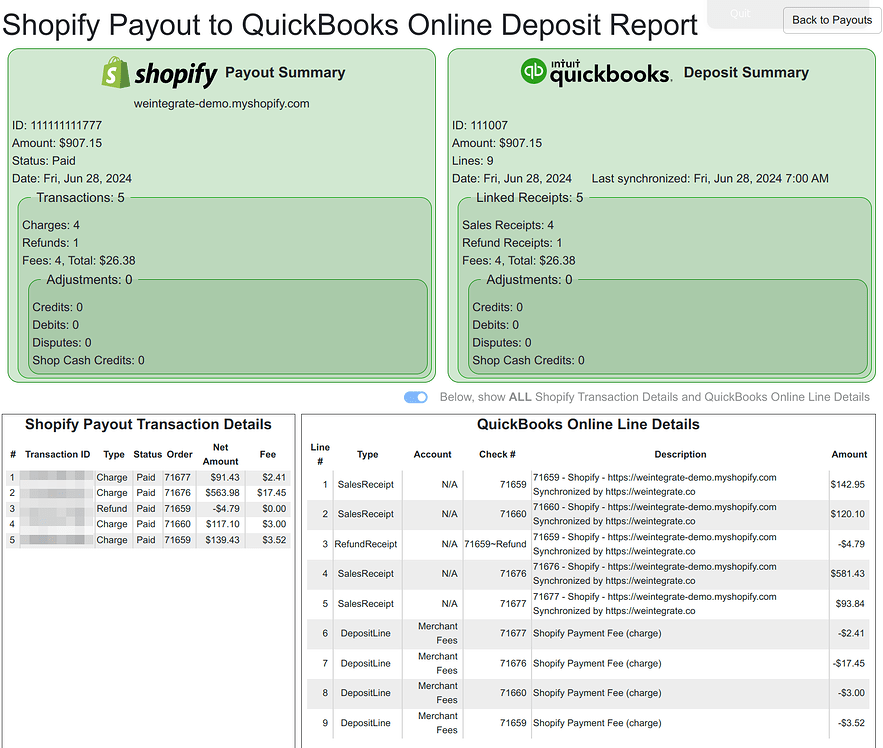
When we create the QBO Deposit, we analyze the Shopify Payout transactions and automatically assign (link) for you each sales receipt and refund receipt that was previously created within QBO when we synchronized the orders and any refunds.
All Shopify processing fees are recorded as the deposit line details. Should there be any credits, charge backs, or disputes – we’ll track that for you as well on the deposit line details.
Further, if we detect the resulting amount of the QBO Deposit differs from the amount of the Shopify Payout, we automatically alert you to this as a discrepancy and provide you with the amount.
While all of this information is available on the QBO Deposit document, when you have a busy store with lots of transactions on the payout — which results in many sales receipts / refund receipts or invoices / credit memos — getting to the information in the current QuickBooks Online Deposit interface doesn’t make it easy to see all the linked receipts (often requiring scrolling through pages) or the credits, charge backs, disputes, and discrepancies.
When you’re trying to figure out why something isn’t right or doesn’t match as expected, you may often need to refer to the details of the Shopify Payout — which not only means you have to have access to it, but you now need to flip between different screens, which can be error prone and time consuming.
To the rescue… Shopify Payout to QuickBooks Online Deposit Report
Shopify Payout Summary and QuickBooks Online Deposit Summary
The report adapts to each payout — you won’t see every section every time. A straightforward payout where everything matched shows just the side‑by‑side summary and (if you toggle it on) the line details. The Discrepancy Detection, Split Detection, Adjustment, and Retail Delivery Fee items below appear only when that situation is actually present in the payout you’re looking at. So if you don’t see one of them, that’s expected — it just means it wasn’t needed for that payout.
The report is a 3 way side‑by‑side, consolidated view of what came in from the Shopify Payout versus what was recorded to the QBO Deposit and highlights detected discrepancies.
On the Shopify Payout side (the source) you’ll quickly see:
- how many transactions in total, and then individually how many charges, refunds, and fees
- how many adjustments in total, and then individually how many credits, debits, disputes, and Shop Cash credits
On the QuickBooks Online Deposit (the destination) side you’ll quickly see:
- how many deposit lines
- how many linked receipts in total, and then individually how many sales receipts, refund receipts, and fees
- how many adjustments in total, and then individually how many credits, debits, disputes, and Shop Cash credits
- how many splits, when any are present (orders recorded on a Journal Entry — see Split payments below)
Discrepancy Detection
Shown only when an amount difference is detected — if the payout and the deposit match, this section simply won’t appear.
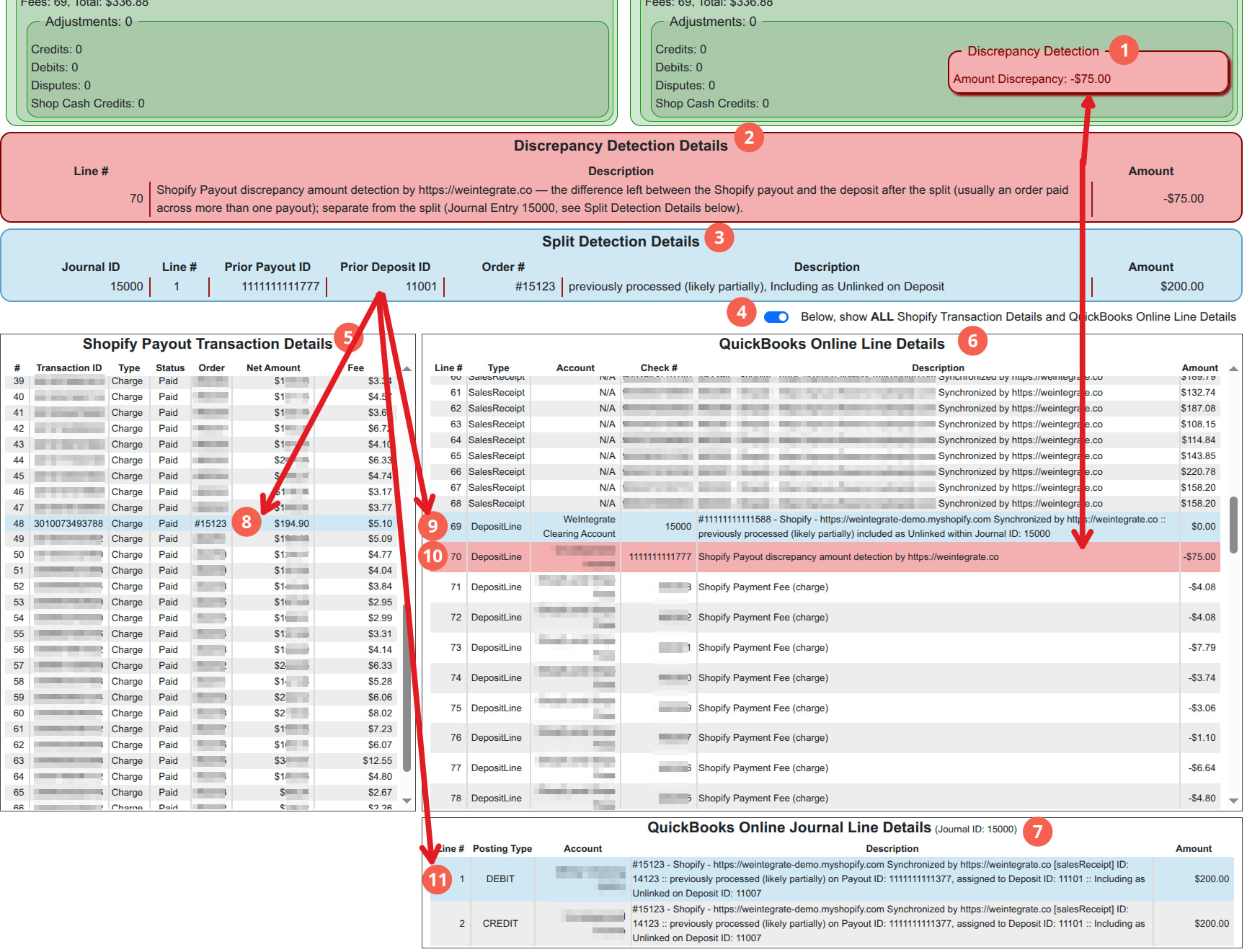
If an amount discrepancy is detected (the amount on the Shopify Payout does not match the amount recorded to the QBO Deposit), a red section is displayed showing the discrepancy amount at the bottom of the QBO side.
A separate section titled Discrepancy Detection Details (#2 in above screenshot) then shows you the exact QBO Deposit line(s), the description, and the amount. Everything tied to the discrepancy is shown on a red background — the alert on the QuickBooks side of the summary, the Discrepancy Detection Details rows, and the exact matching line further down in the QuickBooks Online Line Details (6 of above screenshot) list. The Line # shown in the details is the same number as in that list, so you can jump straight to the precise deposit line at a glance (and find it on the Deposit in QuickBooks).
For busy stores there can be many line details. When a discrepancy is detected, to focus your attention on the issue, we automatically hide the full line details (#4 of above screenshot, turned on for screenshot illustration) — but you can always toggle them back on, where the matching line will be waiting for you, highlighted in red at that same Line #.
How to read the discrepancy amount
The discrepancy answers one simple question: how much of your Shopify payout is not reflected on the QBO Deposit? It is always Shopify payout − the amount recorded to the deposit.
For most payouts that’s the whole story. But when part of a payout is a split (see below), the discrepancy you see is the amount that’s left over after the split is accounted for — not the amount that moved to the Journal Entry. That distinction matters, so we spell it out for you right in the row.
Split payments — when an order is recorded as a Journal Entry
Shown only when one or more of the payout’s orders had to be recorded on a Journal Entry as an Unlinked entity. Many payouts have no splits at all, in which case you won’t see this section or the reconciliation line below.
Sometimes a single order is settled by Shopify across more than one payout. QuickBooks Online allows a sales receipt / refund receipt or invoice / credit memo to assign (link) to only one deposit. So if an order’s document was already assigned (linked) on an earlier payout’s deposit, we can’t link it again here and therefore treat it as an Unlinked entity.
When that happens, instead of skipping it (which would make your deposit short and your books wrong), we record that amount as a Journal Entry — which moves the cash into your bank account — and we flag it for you so nothing is hidden:
- On the QBO Deposit you’ll see a $0.00 reference line (#9 in above screenshot) that simply points to the Journal Entry (so, opening the Deposit in QuickBooks, even without seeing this report you’re informed of the association and you can navigate straight to it).
- On this report you’ll see the Split Detection Details section (#3 in above screenshot) described below.
For your accountant / bookkeeper. The Journal Entry debits your bank account and credits your unmatched‑sales account (an Income account) for the moved receipt — it is the bank‑side counterpart to a receipt that lives on a different Deposit. The Deposit’s $0.00 line carries no amount; it exists purely as a navigation breadcrumb. Combined, Deposit + Journal Entry = the Shopify payout.
The reconciliation line
Appears only for payouts that include a split.
Whenever a payout has a split, the report shows a short, plain‑English reconciliation line directly beneath the Discrepancy Detection Details, for example:
Deposit ($10,865.78) + Journal Entry 15000 ($200.00) = $11,065.78 vs $11,065.78 Shopify payout
This lets you confirm at a glance that the Deposit and the Journal Entry together equal what Shopify actually paid you.
Split Detection Details
Appears only when there is at least one split.
This section (#3 in above screenshot) lists each order that was recorded on a Journal Entry rather than linked to this Deposit, with the following columns:
- Journal ID — the QBO Journal Entry the amount was recorded on
- Line # — the line within the Journal Entry
- Prior Payout ID — the earlier Shopify payout the order was first settled on
- Prior Deposit ID — the earlier QBO Deposit the order’s receipt was linked to
- Order # — the Shopify order number
- Description — a short, plain description of the split
- Amount — the amount that moved to the Journal Entry
This is purely informational — it tells you which orders were split and where their receipt already lives, so a split never looks like a missing transaction.
Color‑coded across all three views
A split touches three different places, and the report highlights all of them in light blue so you can follow it end‑to‑end without hunting:
- the matching Shopify Payout Transaction Details row — so you can see exactly which charge was split (it stays visible even when the rest of the details are collapsed);
- the $0.00 reference line in the QuickBooks Online Line Details — where the order would otherwise have sat on the Deposit; and
- the QuickBooks Journal Line Details row — where the amount actually landed.
The Split Detection Details section ties it all together by calling out the Journal ID, the Prior Payout ID and Prior Deposit ID (where the receipt already lives), and the Order # — so a split reads as a complete story rather than a missing transaction.
When a difference remains after the split
Only relevant when a payout has both a split and a leftover difference — many splits reconcile perfectly and show no discrepancy at all.
Most splits reconcile perfectly: Deposit + Journal Entry exactly equals the payout, and there’s nothing left to flag.
Occasionally a small amount is still left over — almost always because an order was paid across more than one payout, so the receipt’s full total is larger than the portion that actually came in this payout. We don’t leave that floating. We record it as a single, clearly‑labeled line on the QBO Deposit itself — “Shopify Payout discrepancy amount detection” (#10 in above screenshot) — so that:
- Deposit + Journal Entry + this line = your Shopify payout, to the penny; and
- you can see the difference directly in QuickBooks, not only on this report.
In this case the Discrepancy Detection Details (#2 in above screenshot) row shows:
- a Line # equal to the actual QBO Deposit line number where the amount was recorded (so you can find it on the Deposit in QuickBooks) — not the Journal ID, because this amount is on the Deposit, not the Journal Entry; and
- a plain‑English description that makes the distinction explicit, for example:
…the difference left between the Shopify payout and the deposit after the split (usually an order paid across more than one payout); separate from the split (Journal Entry 106258, see Split Detection Details below).
In other words: the split (how much moved to the Journal Entry) and the discrepancy (what’s genuinely left over) are two different things, and the report keeps them clearly apart while still pointing you to the Journal Entry for context.
Retail Delivery Fee (Minnesota & Colorado)
Conditional — this appears only for a specific combination of subscription, settings, and order conditions; most stores will never see it.
If you ship into Minnesota or Colorado, those states charge a Retail Delivery Fee (RDF) on qualifying orders. Users on the weintegrate Enterprise subscription can track these separately via the Destination Fees & Surcharges settings, which let you break each fee out into its own dedicated line item — giving you a clean audit trail and a single QBO Service Item that maps directly to the state‑mandated charge. (See Setting QuickBooks Online Deposit Retail Delivery Fee for how to enable and configure it.)
When that’s in place, the fee is recorded on the QBO sales receipt (so it’s captured on your books), but Shopify does not include the RDF in the payout cash — it’s tracked and remitted separately. Left alone, that would make the deposit look a little higher than the cash you actually received, and show up as a small discrepancy.
So, only for payouts that actually contain RDF orders, we add one clearing line per state to the Deposit to keep it matching the real payout cash — without losing the fee on your books — for example:
MN Retail Delivery Fee collected on orders and remitted via Shopify (not included in payout) — posted to the WeIntegrate RDF Clearing Account
A deposit line to the WeIntegrate RDF Clearing Account described as a Retail Delivery Fee is expected — it’s how we reconcile the fee, not a problem. If your store isn’t on the Enterprise subscription, doesn’t have Destination Fees & Surcharges enabled, or simply doesn’t ship RDF‑eligible orders, you won’t see this line at all.
Adjustment Detection
Shown only when the payout actually contains adjustments.
Similar to the Discrepancy Detection Details, if there are any adjustments we’ll show you a section titled Adjustment Details with a light tan background, which lets you know the exact line, description, and amount — so you don’t need to hunt for it on the QBO Deposit. We highlight each with the same background in the QuickBooks Online Line Details section.
Shopify Payout Transaction Details and QuickBooks Online Line Details
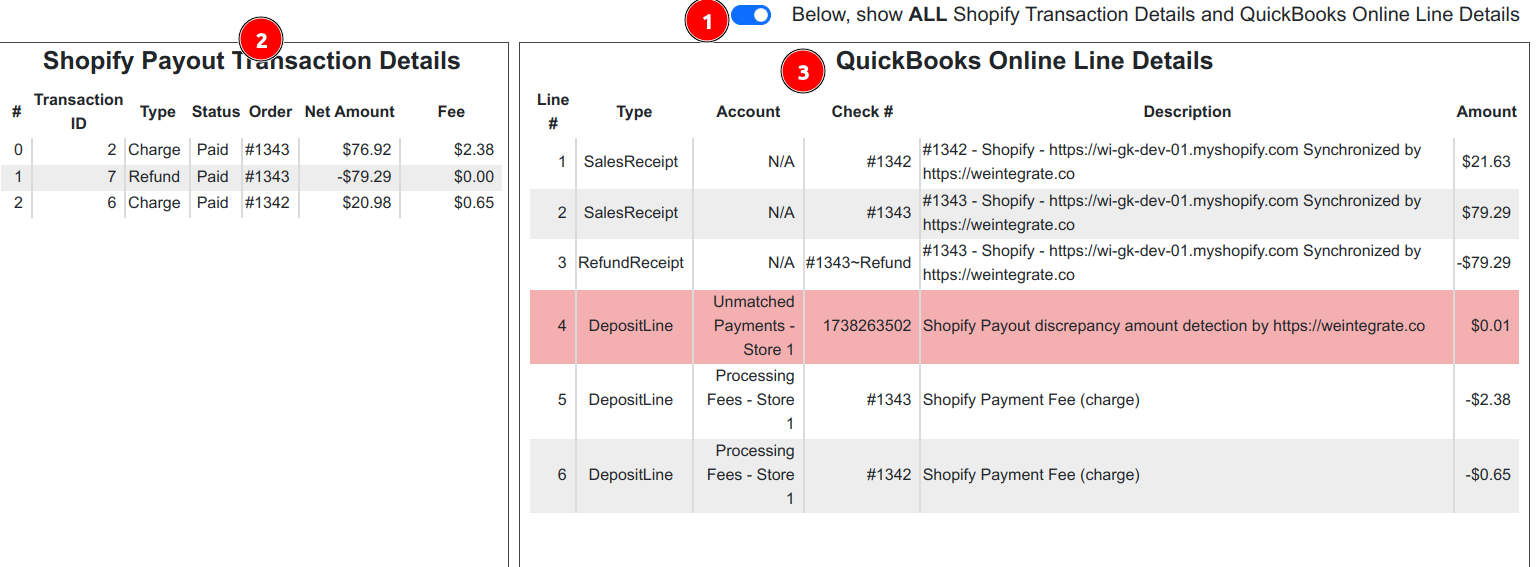
This area of the report places your data side by side so you can follow a single dollar across every place it lives: the Shopify Payout Transaction Details on the left, the QuickBooks Online Line Details on the right, and — whenever a payout has a split — the QuickBooks Journal Line Details as well.
The details can be shown or hidden (when there are no discrepancies or adjustments) by toggling the switch next to Below, show ALL Shopify Transaction Details and QuickBooks Online Line Details. Even when they’re collapsed, anything that needs your attention stays visible and color‑matched across the views — red for a discrepancy, light blue for a split, light tan for an adjustment — so it’s never buried.
Shopify Payout Transaction Details (#2 in above screenshot) has 7 columns:
- # — the transaction line number
- Transaction ID — the Shopify‑assigned transaction ID
- Type — whether the transaction is a Charge, Refund, Credit, Debit, or Dispute
- Status — whether the transaction was Paid
- Order — the Shopify order number
- Net Amount — the amount paid, not including a fee
- Fee — the Shopify fee taken
QuickBooks Online Line Details (#3 in above screenshot) has 6 columns:
- Line # — the deposit line number, helpful should you need to locate it on the QBO Deposit directly. For a discrepancy line this is the actual deposit line that holds the amount; for an informational split reference it points you to the Journal Entry instead.
- Type — whether the line is a linked SalesReceipt, linked RefundReceipt, or a DepositLine
- Account — the account name associated with the line. Hovering shows a tooltip with the account ID. When the Type is a linked SalesReceipt or RefundReceipt, this shows N/A, as QBO automatically handles the accounts within the linking.
- Check # — the associated Shopify order number as reflected on the Sales Receipt or Refund Receipt
- Description — the description of the line
- Amount — the amount
QuickBooks Journal Line Details (appears only when the payout has a split) shows the Journal Entry’s lines — the entry that moves the receipt’s cash into your bank and its offsetting line — highlighted in the same light blue and cross‑referenced to the Split Detection Details above (matching Journal ID and Line #), so you can trace a split from the Shopify charge, to where it would have sat on the Deposit, to where it actually landed in the Journal Entry.
Quick reference — deposit lines you may see
Not every payout will include every line below — each one appears only when it’s relevant to that payout:
| Line you may see on the Deposit | When it appears | What it means | Where it posts |
|---|---|---|---|
| Linked Sales Receipt / Refund Receipt or Invoice / Credit Memo | Whenever an order/refund matched | An order (or refund) we matched and linked for you | QuickBooks handles the account via the link |
| Shopify Payment Fee | Whenever a charge has a fee | A Shopify processing fee for a charge | Your configured payment‑fee account (Cost of Goods Sold / Expense) |
| Credit / Debit / Dispute / Shop Cash Credit adjustment | Only if the payout has that adjustment | A payout adjustment, surfaced in Adjustment Details | The configured adjustment account |
| Retail Delivery Fee clearing line (MN / CO) | Only on the Enterprise subscription with Destination Fees enabled, and only for payouts with RDF orders | Reconciles the state RDF that’s on the receipt but not in the payout cash | WeIntegrate RDF Clearing Account (Other Current Asset) |
| $0.00 split reference line | Only when an order was recorded as a split | A breadcrumb pointing to the Journal Entry for that order | WeIntegrate Clearing Account (Other Current Asset) |
| Shopify Payout discrepancy amount detection | Only when a genuine difference remains | The leftover difference (after fees, RDF, and any split) | Your configured unmatched‑sales account (Income) |
A note for accountants & bookkeepers
Everything above is designed so your QuickBooks bank account always reconciles to the actual Shopify payout, with no double‑counting and no amounts landing in the wrong place — and each mechanism only kicks in when its situation is present:
- Deposit + any Journal Entry + any discrepancy line = the Shopify payout, every time.
- Splits (receipts already deposited on an earlier payout) are recorded as a Journal Entry that debits the bank and credits your unmatched‑sales account (an Income account); the Deposit carries only a $0.00 reference line to it.
- Retail Delivery Fees — when enabled on the Enterprise subscription via Destination Fees & Surcharges — are offset to a dedicated WeIntegrate RDF Clearing Account (Other Current Asset) so the Deposit matches the payout cash while the collected fee stays on your books.
- Discrepancies post to your unmatched‑sales account (an Income account) — identically whether or not a split is involved — and, for an order split across payouts, net to zero once its other portion lands on a future payout.
- Income is still recognized once, on the original Sales Receipt; the clearing and discrepancy lines never touch your sales/income accounts.
As always, if a number doesn’t look right, this report puts the Shopify payout and the QBO Deposit side by side — with the splits, fees, adjustments, and the one true leftover all called out (when they apply) — so you can see exactly where every dollar went without leaving the page.